Tuesday, 25 May 2021

What hath God wrought


Lord Kelvin (1824-1907) was born in Belfast, the son of a Scottish father and an Ulster-Scots mother.  He was the greatest scientist of the Victorian era, a devout Christian, and a Liberal Unionist.

He took a great interest in the laying of a telegraph cable under the Atlantic and helped to ensure its success.  This was the greatest of all Victorian engineering projects and when it was completed in 1856 the first message to be sent was: 'Europe and America are united by telegraphic communication. Glory to God in the highest, on earth peace, and goodwill towards men.'  (Luke 2:14)

Going back a little further the telegraph was developed by a Scotch-Irish inventor  Samuel F B Morse (1791-1872), who invented Morse Code.  In May 1844 Morse inaugurated the world's first commercial telegraph line with a message sent from the US Capitol o a railway station in Baltimore.  The message was: 'What hath God wrought.' (Numbers 23:23)

Both Morse and Kelvin were men who knew and loved the Bible as the Word of God.


Wednesday, 17 February 2021

Scotland's 'once in a lifetime' referendum


When SNP leader Alex Salmond appeared on the Andrew Marr programme on BBC television on the Sunday before the Scottish Referendum in September 2014 he said:  'In my view this is a once in a generation - perhaps even once in a lifetime - opportunity.'

Later he denied ever saying 'once in a lifetime' and insisted he had said 'the opportunity of a lifetime'.  He even described that September 2014 promise as a 'collective myth'.

However footage of the interview and an official transcript showed that he had used the 'once in a lifetime' phrase when asked whether he would pledge not to 'bring back another referendum' if the nationalists lost.  

'Once in a lifetime' - that statement was unqualified and unconditional and Nicola Sturgeon did not dissent from it but the SNP was trying to rewrite history.

The SNP simply could not accept that they had lost and are determined to turn a referendum into a neverendum.

Monday, 15 February 2021

Another Ulster-Scots dynasty in America

Browsing on the internet tonight I came across another prominent American family of Ulster-Scots descent, the Bankhead family of Alabama.

James Bankhead (1738-1799) emigrated from Ulster in the 18th century along with two brothers and settled in South Carolina.,  There he married  Elizabeth Rhea Black (1746-1837), a name that suggests she too was of Ulster-Scots descent, and they were the parents of George Bankhead, who married Jane A Greer.

In 1818 members of the family moved south from Union County in South Carolina into Lamar County, Alabama, and James Greer Bankhead, a son of George and Jane Bankhead, fought in the Mexican-American War.

He lived on the Bankhead plantation in Lamar County and around 1850 he built a fine house which is still there and is on the National Register of Historic Places.


James G Bankhead was the father of John Hollis Bankhead (1842-1920), who served in the Civil War and married a woman named Tallulah Brockman.

She was descended from the Revolutionary War hero Colonel Benjamin Kilgore (1738-1802).another Ulster-Scot whose father James Kilgore (1701-1771) emigrated from Ulster some time before 1734 along with two brothers.  Benjamin's wife Elizabeth Jack (1717-1792) was also an Ulster-Scot and so we have three lines of Ulster-Scots ancestry.

The family were originally Presbyterian but like many Scotch-Irish Americans they converted to Methodism some time in the 19th century.

John Hollis Bankhead had a long political career in both state and federal government.  He served in the Alabama House of Representatives and the Alabama Senate before being elected to the United States House of Representatives and the United States Senate.    He was a Democrat and served in the Senate from 1907 to 1920.

His name lives on in the Bankhead Highway, Lake Bankhead, near Birmingham, Alabama, and the Bankhead Tunnel in Mobile Alabama, as well as the William B Bankhead National Forest.

His son John H Bankhead II (1872-1946) was also a United States Senator and another son William B Bankhead (1874-1940) had an even more distinguished career as a United States Congressman.  In 1934 he was chosen House Majority Leader by his fellow Democrats and in 1936 he became Speaker of the House, a position now held by Nancy Pelosi.

The actress Tallulah Bankhead (1902-1968) was a daughter of William B Bankhead.

The Bankheads were one of the most notable families in the history of Alabama.

There is often a tendency to focus on famous Scotch-Irish presidents and pioneers but the Ulster-Scots influence in America can be seen in almost every area of life and the Bankheads were certainly a notable family.

Wednesday, 20 January 2021

There is history in Belfast's street names

Thomas Carnduff

The street names in a town can often tell us much about the history of the town and that is certainly true of Belfast,

The old medieval castle is long gone but we still have Castle Place and Castle Street to remind us of the castle and its location..

Meanwhile Bridge Street marks the point where a bridge crossed the Farset River, before the river was culverted to create High Street.

One of Belfast's notables, Thomas Carnduff, certainly recognised that when he wrote in the Belfast Telegraph (29 July 1939): 'The history of Belfast is not to be found in the printed book but in the street names.  Ann Street, Joy Street, May Street, Arthur Street.  Not mere visionary names, but borne by people whose lives were linked with the progress and life of the city itself.'

No, Donald Trump did not coin the term 'fake news'


I was surprised to hear a Sky News reporter state that Donald Trump 'coined' the term 'fake news'.  In fact that statement is itself 'fake news'.

Donald Trump may have popularised the term 'fake news' and he certainly used it more than anyone else I can think of but he didn't coin it.

The term 'fake news' was already in use in the 19th century.  Then it was used by newspapers and magazines to boast about the quality of their own journalism and attack that of a rival, which would then be described as publishing 'fake news'.

In 1895 the journal Electricity claimed that 'we never copy fake news' and the following year a writer at a newspaper in California attacked the publisher of another newspaper stating, 'It is his habit to indulge in fake news.  He will make up news when he fails to find it.'

Fake news seems to have been an issue at that time because the Toronto Daily Mail (13 June 1893) carried a report headed 'FAKE NEWS'.  It stated that the Connecticut legislature had introduced a bill providing for the punishment of people who sent 'fake news' to newspapers.

Some earlier newspaper reports used the term 'false news' but gradually 'fake news' became the preferred term and it was in widespread use long before Donald Trump was even born.


Tuesday, 19 January 2021

The 90% dominance of the Left in universities


Since the 1960s there has been a political imbalance in universities in the British Isles and North America.  It is an imbalance in which the left is predominant and an imbalance which has been increasing, decade after decade.

In 2017 the Adam Smith Institute published a report on British universities titled Lackademia: why do academics lean left?

There have also been reports on academics in American universities and colleges and in fact the imbalance on both sides of the Atlantic follows the same general pattern.  That is one reason why it is worth keeping an eye on the current position in America.  Another is that there is some interchange with academics crossing in both directions.

A recent investigation by a conservative website, The College Fix, used an interesting technique to assess the imbalance in universities across the USA.

They looked at data collected by the Federal Elections Commission from employees who named their employer as a university and so were able to compare universities and states.  The data included lecturers, faculty, professors, administrators, librarians and other employees.


Florida is a good example to look at because politically it is fairly balanced between Republicans and Democrats.  In the 2016 presidential race Donald Trump took 49% of the vote and Hilary Clinton took 48%.  In 2020 Trump increased his vote share to 51% with Joe Biden taking 48%.

So how did the seven largest universities in a politically balanced state fare in terms of donations to the two parties?

In the past two years nearly 89% of political donations from faculty members in the seven Florida universities were given to the Democrats with just 10.6% going to Republicans - roughly 90% and 10%.

In Ohio the percentage of political donations that went to the Democrats was even higher at 92% and in Pennsylvania it was 96%.

The long march of the Left through the corridors of academia continues unabated.


Friday, 11 September 2020

The inventive wife of a Scotch-Irish businessman

Cochran-3662.jpg
William Apperson Cochran (1831-1883) was a Scotch-Irish businessman, politician and public official, with family roots in county Antrim.

He was a son of James Cochran (1813-1895) and his wife Nancy Caroline Templeton (1808-1895), both of whom were Scotch-Irish.  

His paternal grandparents were John Cochran (1760-1853) and his wife Martha McCaslin (1772-1845) and Martha was also Scotch-Irish.  His grandfather was a veteran of the American Revolution and he fought at King's Mountain.

However it is his wife who is better remembered and she has left us a lasting legacy, which most of us appreciate.  She was born Josephine M Garis (1841-1913) and they lived in Shelbyville, Shelby County, Illinois.


Josephine Cochran was inducted into the US National Hall of Inventors in 2006 and her invention was the 
first practical mechanical dishwasher, which she demonstrated in 1886.
She was a rich woman who held many dinner parties and while she had servants to wash the dishes she wanted a machine that could do the job faster without chipping any dishes.  No one had invented a practical dishwashed and so she built one herself.

She patented the design, went into production and showed her invention at the 1893 World's Columbian Exposition in Chicago.  There she won the highest prize for the 'best mechanical construction, durability and adaption to its line of work'.  She started the Garis-Cochran Manufacturing Company which eventually became part of the Whirlpool Corporation.


Saturday, 5 September 2020

A Presbyterian moderator's insight

Rev Dr John Henry Orr was the moderator of the Presbyterian Church in 1887 and in that role he gave an address at an event in Londonderry on 23 August 1887 to honour the laying of the foundation stone of the new Town Hall.  

The function had been organised by The Honourable the Irish Society, which had a central role in the settlement of Londonderry in the 17th century.  In the course of his remarks Dr Orr said that the members of the Presbyterian Church had a peculiar aptitude for civic administration, arising, he believed, out of their Church system of self-government.

The system of presbyteries, kirk sessions and church committees involved members of the congregation in the governance of their churches and thereby members gained experience that stood them in good stead in civic society.


Dr John Henry Orr was minister of the High Street Presbyterian congregation in Antrim and for many years he was clerk of the General Assembly.

A similar observation has been made about the way in which Methodism in England provided a number of the early leaders of the trade union movement, who had gained experience as lay preachers in their local churches.  


Friday, 4 September 2020

Sir Charles Villiers Stanford - British Covenanter


Sir Charles Villiers Stanford (1852-1924) was born into a Protestant and Unionist family in Dublin but moved to England, where he played an important role in the renaissance of British classical music.

He lived through the three Home Rule crises and was a firm supporter of Ulster unionists in their opposition to Home Rule for Ireland.  

In 1913 he welcomed the formation of the Ulster Volunteer Force by Carson, Craig and the Ulster Unionist Council and in 1914 he signed the British Covenant, which was launched by the League of British Covenanters, who were British supporters of Ulster

Stanford's interest in Ulster was also reflected in his music, including his song settings of the Ulster-Scots poet John Stevenson's Pat McCarty: His Rhymes (1910), his Irish Rhapsody No 4 (1913), also known as The Fisherman of Lough Neagh and What He Saw and the Ulster March (1913).

The Unionist cause had the support of the overwhelming majority of Ulster Protestants but it also enjoyed substantial support in Great Britain, including that of prominent cultural figures such as Sir Charles Stanford, the poet Rudyard Kipling and Sir Edward Elgar, another important musician, who was a Roman Catholic.  

Advocating for the Union and cultivating support for the Union are vital for the preservation of the Union.


Friday, 24 April 2020

The New Lodge mural that celebrates a unionist


This photograph of a wall mural appeared recently in a local Belfast newspaper.  

The mural is in the Nationalist New Lodge Road area of north Belfast and depicts Dr William Drennan (1754-1820), a Belfast-born Presbyterian who was the founder of the Society of United Irishmen.

Most of the murals in that area depict Irish republicans so it is nice to see that they also have a mural of a former United Irishman who became reconciled to the Act of Union.

Indeed in the Belfast Monthly Magazine on 31 December 1811 he urged his readers to:
Be Britons with all your souls - and forget that your father called himself an Irishman.
Now the mural, as we see it in the photograph is not in great shape.  It clearly needs repainted.  So perhaps when someone gets round to refreshing the mural of William Drennan they might consider a new quotation, such as one above.

Those words would look well on a wall in the New Lodge - 'Be Britons with all your souls - and forget that your father called himself an Irishman.'


Wednesday, 22 April 2020

An Irish-American attack on the Scotch-Irish

From Migration to Music: The Scotch-Irish Contributions to America ...The Scotch-Irish Society of America was founded in 1889 under the presidency of Robert Bonner (1824-1899), a wealthy New York newspaperman and a Presbyterian Ulster-Scot who had emigrated from Londonderry.

It held its first Congress in Columbia, Tennessee, in May 1889, its second Congress in Pittsburgh, Pennsylvania, in June 1890, its third Congress in Louisville, Kentucky, in May 1891 and a fourth Congress in Atlanta, Georgia, in April 1892.  These continued for a number of years and the proceedings were published in bound volumes.

That fourth Congress ended on 1 May 1892 and a week later it drew an angry response in a weekly Pittsburgh newspaper, the Irish Pennsylvanian, which was edited by John Flannery, an Irish-American activist and a former miners' organiser.  

The newspaper, which was also known as the Irish Pennsylvanian and Catholic News, was published from 1890 to 1921 but Flannery was not particularly well regarded by some sections of Irish-American opinion.  When Paul Sheedy wrote to the Fenian leader John Devoy on 11 November 1895 he said of Flannery: 'He is ready to do anything for a dollar.'

Nevertheless his attack on the Scotch-Irish is worth examining for what it tells about Irish-American thinking at that time.

The response to the fourth Scotch-Irish Congress was published under the title THE SCOTCH-IRISH and deployed several fallacies in support of its argument.

The first was to attack the validity of the term Scotch-Irish:
The whole idea of Scotch-Irish is a new-fangled notion, first promulgated in America.  It was born of sheer ignorance, and pharisaical pride.  There never was a true, whole-souled Irishman yet who unless he was ignorant of the facts, would claim such a bastard, mongrel, origin.  
The name was not known when glorious Henry Joy McCracken and Henry Monroe led the Irish Northern Presbyterians against the British at Ballynahinch. ... The words Scotch-Irish had not emanated from the brain of some bawbee-scraping lowland Scotchman when old Andrew Jackson, with the fires of Shane O'Neill blazing in his eyes, gave an Irish-American greeting to the British hirelings at New Orleans. ... This Scotch-Irish idea ought to be abandoned.
Scots-Irish-settlementThe author of this diatribe was clearly unaware of the fact that the term 'Scotch-Irish' was recorded in Maryland as early as 1689/1690, a full century before the Henry Joy McCracken took part in the 1798 rebellion and 125 years before Andrew Jackson fought the Battle of New Orleans in 1815.

When the Irish Pennsylvanian published the article in 1892, the term Scotch-Irish had been in use for at least two centuries and yet the writer dismissed it as 'a new-fangled notion'.

The second was to argue that Scottish names were really of Irish origin and one example cited was:
The Lindsays come from one of the Lynotts who escaped the massacre of his family by the Barretts of Tyrawley in Connaught.
In fact the name Lindsay is of Old British and Anglo-Norman origin.  The name was brought to Britain with the Anglo-Normans who came to England with William the Conqueror in 1066. and from there it was taken north to Scotland and was recorded there in 1180.

As regards the Lynotts I understand the name was brought to Ireland by Anglo-Normans or Cambro-Normans who came from England or Wales and settled in Connaught in the 13th century.

So both names have an Anglo-Norman origin and neither has a Gaelic origin!

No photo description available.That article was written in 1892 and in 1897 a number of Irish-Americans formed the American Irish Historical Society, which stridently opposed the use of the term Scotch-Irish.

More than a century later there are still some Irish propagandists who try to deny the legitimacy of those who identify as Ulster-Scots on this side of the Atlantic or Scotch-Irish on the other side.

Moreover they still deploy many of the same false arguments and they often display the same intolerance.

Thankfully their arguments are easily exposed and refuted.

We should be able to celebrate our cultural traditions and cultural identities without castigating or denigrating others.


Friday, 17 April 2020

America's debt to Ulster

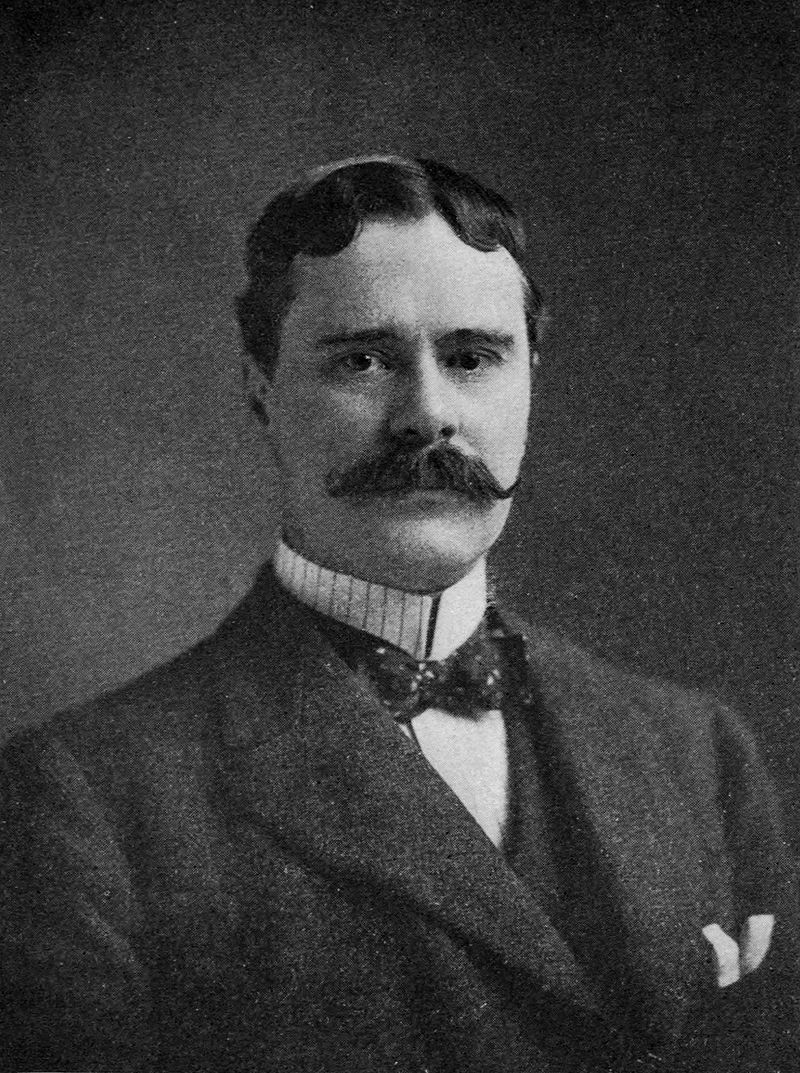
Owen Wister.jpg
Owen Wister (1860-1938) was an American author and historian.  He is best remembered as the author of The Virginian and a biography of Ulysses S Grant and he was a lifelong friend of President Theodore Roosevelt

Wister was a supporter of the unionist cause in Ulster and in his book A Straight Deal Or The Ancient Grudge (1920) he wrote: 

'Americans are being told in these days that they owe a debt of support to Irish independence, because the Irish fought with us in our own struggle for independence.  Yes, the Irish did, and we do owe them a debt of support. But it was the Orange Irish who fought in our Revolution, not the Green Irish.' [p 259]

He went on to quote his good friend Theodore Roosevelt who wrote in his History of New York:
'It is a curious fact that in the Revolutionary War the Germans and Catholic Irish should have furnished the bulk of the auxiliaries to the regular English soldiers;  ... the fiercest and most ardent Americans of all, however, were the Presbyterian Irish settlers and their descendants.' [p 133]

At that time in the early years of the 20th century Irish republicans were endeavouring to gain American support for their cause.  They had support among a core of Irish-Americans but Americans in general were not deceived by fabricated arguments such as that identified by Owen Wister.

His book illustrates the understanding that there was at that time of the Ulster unionist cause in countries such as the United States of America and it is significant that it was penned by someone who was a close friend of some of the leading figures of the day.

Monday, 30 March 2020

Bute House was once the family home of a Unionist MP


Bute House in Edinburgh is the official residence of the First Minister of Scotland and currently occupied by Nicola Sturgeon of the SNP.

However it was once the childhood home of a Scot who was the Unionist MP for North Down from 1910 to 1918.  

Lord Selsdon.jpg
William Mitchell-Thomson MP
His name was Sir William Mitchell-Thomson (1877-1938) and he was the son of Sir Mitchell Mitchell-Thomson FRSE FSA (1846-1918), a Scottish merchant and businessman who served as Lord Provost of Edinburgh from 1897 to 1900.

He was born at 7 Carlton Terrace in Edinburgh on 15 April 1877 but his father bought Bute House after the death of the previous owner in 1887 and lived there for thirty years until his death in 1918,

William Mitchell-Thomson was married in 1907 and presumably thereafter he had his own residence but during the time that he was MP for North Down, a period that covered the home rule crisis and the Great War, he would have been a regular visitor to his father's home at Bute House.

The grandeur of the house reflected the wealth and influence of the family and such influence played an important part in the Ulster Unionist campaign against home rule.


Sunday, 22 March 2020

'I was in the Spirit on the Lord's day'

We hear a lot today about 'self-isolation' and 'social distancing' and those words remind me of a man in the Bible who also experienced isolation and social distancing.

John had been a disciple of Jesus, one of the twelve, and is described as 'the disciple whom Jesus loved'.  He had served the Lord faithfully and had already written four books of the New Testament.

However there was a time when Christians were experiencing persecution by the Roman authorities and John was banished into exile, to Patmos, a small, rocky island in the Aegean Sea.  By then he was well on in years and the last remaining of the twelve disciples.

In Revelation 1:9 he wrote: 'I John, who also am your brother, and companion in tribulation ... was in the isle that is called Patmos, for the word of God and the testimony of Jesus Christ.'

He was far away from his friends and his fellow believers and he was unable to meet with them on the Lord's Day as he would normally have done (Hebrews 10:25).  There on Patmos he experienced isolation and tribulation but he was able to say that he was 'in the Spirit' on the Lord's Day.

Image result for patmos mapHe was isolated from his fellow-believers and he was far distant from them but there on Patmos he met with God and God met with him.  Indeed God spoke to him, giving him a wonderful revelation, which is now the last book in the Bible.

Even though we may not be able to meet today, at least physically, with other believers, other than those in our immediate household we can meet with God.  We too can be 'in the Spirit on the Lord's Day.

The phrase that is translated 'the Lord's Day' is different from 'the day of the Lord' and appears only once in the New Testament.

Moreover the same word that is translated 'the Lord's' appears in only one other place in the New Testament and that is in the phrase the Lord's Supper.  I believe that links the two together - the Lord's Supper and the Lord's Day.

The Lord's Supper is a reminder of the Lord Jesus Christ dying as our substitute, for our sin, at Calvary..

The Lord's Day is a reminder of the Lord Jesus Christ rising from the dead on the first day of the week (John 20:1).

Living He loved me, dying He saved me;
Buried He carried my sins far away;
Rising He justified, freely forever;
One day He's coming, O glorious day.
John Wilbur Chapman (1859-1918)

If we know Him as our Saviour and Lord, the one who died for us, the one who rose for us, and the one who is coming again for us, then we too can be 'in the Spirit on the Lord's Day', wherever we may be.

Tuesday, 28 January 2020

UK economy is bigger than 18 smallest EU countries combined

Image result for united kingdom and european unionYesterday the Irish prime minister Leo Varadkar told the BBC: '"The European Union is a union of 27 member states. The UK is only one country. And we have a population and a market of 450 million people.'  He was arguing that the UK is 

Yes it is true that the European Union is a union of 27 countries.

However as Alexander Von Schoenburg recently pointed out in a British newspaper: 'Your economy is bigger than the 18 smallest EU countries combined. This means in economic terms that the EU will lose not just one member state — but shrink from 28 members to ten.'

Leo Varadkar should remember that arrogance is never attractive and that a little more modesty would go a long way.

The United Kingdom may be a country of modest size but it has the fifth largest economy in the world.

Sunday, 26 January 2020

Hugh McCalmont Cairns - a great Ulster-Scot (1)

Last month was the centenary of the birth of Hugh McCalmont Cairns (1819-1885), who was Lord Chancellor of England 

Born in Belfast and named Hugh McCalmont Cairns, it is not difficult to recognise him as an Ulsterman with Scottish roots and heritage.

The first of the family to settle in Ulster came from Kirkcudbright in Scotland.  They were a distinguished family and a baronetcy, which soon became extinct, was conferred on an Alexander Cairns for military service under the Duke of Marlborough. 

Hugh McCalmont Cairns was the second son of William Cairns, who had been born at Parkmount in north Belfast and had served as a captain in the 47th regiment of foot.  His mother was Rose Anna Johnston, daughter of Hugh Johnston, a Belfast merchant.

He was born on 27 December 1819 and was educated at Belfast Academy, now Belfast Royal Academy, and Trinity College Dublin.  The name is remembered in the Belfast Royal Academy, where one of the four houses.is still named Cairns.

Hugh McCalmont Cairns studied law and was called to the Bar in 1844 but in 1852 he entered parliament as MP for Belfast, a position he held until 1866.

He was Lord Chancellor of Great Britain in 1868 and then in 1869 became leader of the Conservative opposition in the House of Lords.  Cairns was Lord Chancellor for a second time from 1874 to 1880.

Cairns was a devout Christian, with a firm faith in Jesus Christ, and he was a thoroughly evangelical Protestant.  He never allowed the demands of his legal and political work to impinge on the Lord's Day and for many years he was a Sunday school teacher.  Here was one of the great statesmen of the day, a man who deliberated on weighty matters of law, taking the time to teach boys and girls.  He was also a keen supporter of the philanthropic work of Dr Barnardo and Cairns House, one the Barnardo homes, was named after him.

He loved to hear the gospel preached and once said that to hear D L Moody preach the gospel and Ira D Sankey sing the gospel was the richest feast he could enjoy.

His half-brother Sir William Wellington Cairns KCMG (1828-1888) was Governor of Queensland and later Administrator of South Australia.

The centenary of the birth of this great Ulster-Scot passed, as far as I can see, unnoticed and that is regrettable.  A Conservative statesman, an evangelical Christian and a convinced unionist, he is someone who deserves to be remembered.

The current Lord Cairns is Simon Dallas Cairns, 6th Earl Cairns, who was born in 1939.


Saturday, 25 January 2020

'Iceland hasn't eliminated Down's syndrome - they are just killing everyone who has it'

Photograph from CBC - USA

Yesterday Mary and I met up in Belfast city centre and went into a shopping centre to get something to eat. 

At the tables beside us were a group of young people with learning disabilities, who were chatting away to each other..  

The person nearest to us was a teenage girl with Down's syndrome and we were both struck by her laughter, her intense conversation with her friend and especially her ability with her iphone.

Indeed Mary and I both remarked that we would love to have some of the technical facility with the iphone that she had displayed.

Here was a young woman who was enjoying life, experiencing joy and bringing joy to others, and yet if she had been conceived in a country such as Iceland her life would almost certainly have been ended before she was born.  

In Iceland almost all unborn children who are believed to have Down's syndrome are aborted.

Pro-abortionists in Iceland claim that they have virtually eliminated Down's syndrome through abortion and indeed only two or three children are born each year with Down's syndrome.

However as American actress Patricia Heaton tweeted: 'Iceland isn't eliminating Down syndrome - they are just killing everyone who has it.'


Saturday, 31 August 2019

Belfast's 'Stop the Coup' debacle


Across the United Kingdom there have been thousands of people out protesting against Brexit.  They may argue that it is about the length of the prorogation of Parliament, that few extra days, but it is  really about Brexit.


There have been sizable crowds in London and some of the cities in England today though other protests have been rather poorly attended.

So how did Belfast fare?  I was waiting for the BBC and Sky to provide coverage of the Belfast demonstration, which started at 10.00 am at the City Hall.  However Belfast didn't seem to feature.  Instead I had to rely on the Press Association and newspaper websites and they did provide helpful reports with a few photographs and several interviews.  

The first thing that struck me was the dismal turnout which was described as 'dozens'!  The highest estimate appeared to be the one quoted by the Irish Times reporter, which was 'around 100'.

'Dozens!' I said to myself, 'dozens!'  After a Liberal Democrat MEP telling us ,a few days ago that Brexit would lead to 'unprecedented violence' and after all the outrage from the Alliance Party, the SDLP and Sinn Fein, I was expecting thousands on the streets.  But all they got was a few dozen and here's the photograph from the Press Association to prove it.

Brigitte Anton

Well they were right there, dozens it was!  So what about those interviews?

Brenda Gough from West Belfast, 'one of those who had promoted the event', was interviewed and said, 'We no longer have democracy because elected representatives of the people of the UK have been told they will no longer be able to speak for their electorate.'    Sorry Brenda but is Parliament not sitting next week?

Susie Burlace (46) from England edits a health journal and has been living in Northern Ireland for seven years.  Later she said, 'Good turn out at Belfast City Hall.'

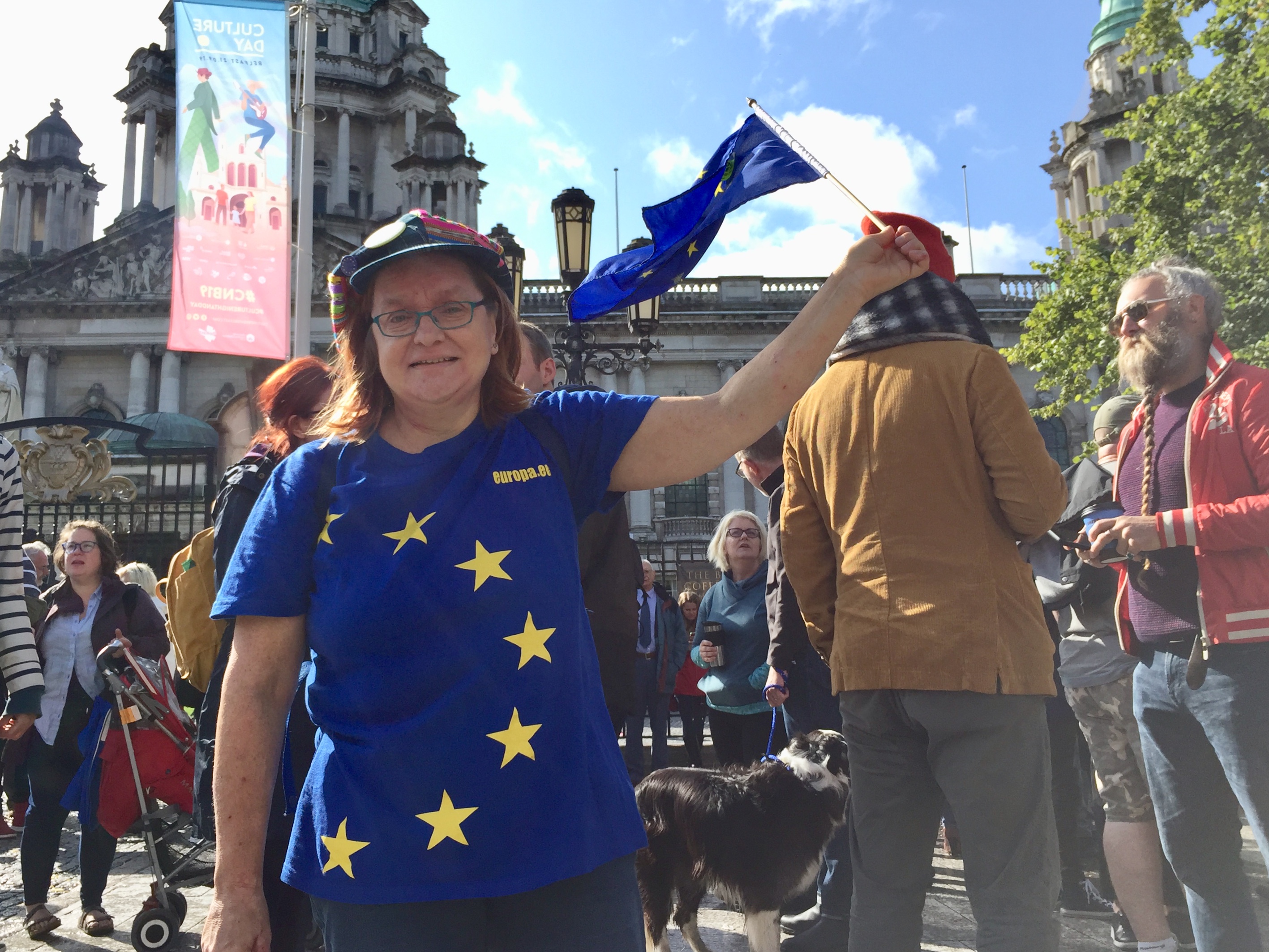
Dr Brigitte 'Gitty' Anton (52) (pictured above) is from Frankfurt in Germany but has lived in Northern Ireland for 31 years.  She was there with her EU flag and a T-shirt with the message 'B....x to Boris'.  A former vice-chair of the Labour Party in Northern Ireland, she stood for the Northern Ireland Assembly in South Belfast in 2016 and polled just 246 first preference votes.  As she has a PhD in modern history and as she is from Germany I would have hoped that she might not go down the road of  comparisons with the Nazis but she did.  She drew parallels between the prorogation of Parliament and Nazi Germany.

Patrick Yu from the Council for Racial Equality was there too as was Londoner Rob Stead, who said he and his wife had'fled' England to move to Northern Ireland because they were so dismayed by the Brexit vote.  In fact his wife is studying at Queen's.

Graham Glendinning (49), a software worker from Holywood, said, 'If they go ahead with no deal, it's war and peace for us.'  I'm not clear as to what he meant by that but that's what he  said.

The media coverage given to such protests is out of all proportion and where they get a dismal turnout it gets glossed over.


Monday, 3 June 2019

The BBC, the Trotskyist and 'toxic politics'

Image result for chris nineham

This morning, as US president Donald Trump arrived in the United Kingdom, the BBC Breakfast programme reported that there would be tens of thousands of people out on the streets of London to oppose his visit.

They also interviewed Chris Nineham who was identified on screen as being from the 'Together Against Trump campaign' and who denounced the 'toxic politics' of Donald Trump.

I must confess that I was unfamiliar with the name Chris Nineham but he came across as an articulate individual, probably in his late 50s, and that is how most viewers would have seen him.

However there is a lot more to Chris Nineham than that.  The son of a professor at Oxford University, he was educated at Westminster School which sits in the shadow of Westminster Abbey in London and is one of the most expensive independent schools in Britain.  

In spite of this rich and privileged background he embraced the politics of the far-left and was a member of the Trotskyist Socialist Workers Party until he resigned in 2010.

Since then he has been a leading member and spokesman of several front organisations and he is vice-chair of the Stop The War Coalition, an organisation that was set up by the far-left, including members of the Socialist Workers Party.

In case there is any doubt about his own politics, Chris Nineham is a far-left political activist and author.  He has written several books on Marxist politics as well as contributing articles to the far-left Morning Star newspaper.

One of his books, Capitalism and Class Consciousness, explores the ideas of the Marxist Georg Lukacs and another is titled How the Establishment Lost Control.

As regards the Middle East. Nineham was filmed speaking in Strasbourg in 2009.  On that occasion he told his audience:
The resistance of the Lebanese people, led by Hezbollah, and the heroic resistance of the Palestinians in Gaza has, um, constrained and demoralised the Israeli project.
Hezbollah and Hamas are terrorist organisation and so when it comes to condemning 'toxic politics', Chris Nineham is in no position to criticise anyone.  Most people would regard support for Hezbollah as fairly 'toxic'.

Image result for chris nineham george class consciousnessNineham has also been challenged about the way in which the far-left protests against America while remaining silent about Russia.

So the articulate middle-aged man whom the BBC interviewed today is not merely a spokesman for 'Together' Against Trump'.  

He is a life-long far-left political activist.

The BBC aspires to fairness and transparency so surely it is time for the BBC to consider how it describes such activists and how it interviews them.  

There are two sides to this debate and if there is to be scrutiny of Trump there should also be scrutiny of the protestors.

Viewers have a right to know who is being interviewed and the far-left, whether Marxists, Trostkyists, Stalinists or whatever should not be allowed to hide behind the name of their latest 'front organisation'.


Friday, 31 May 2019

When is a QUB professor a 'nationalist' professor?


Yesterday I was invited on to the Talkback programme on Radio Ulster to discuss Nicola Sturgeon's call for another independence referendum in Scotland.  

The other person in the studio, apart from the presenter, William Crawley, was Colin Harvey, who is a Professor of Law at Queen's University.

I was introduced as a 'unionist analyst' and Colin was introduced as a Queen's University law professor.

I have no objection at all to being described as a 'unionist analyst' because I am a unionist.  However I did wonder why Colin was not described as a 'nationalist law professor' from Queen's.

I didn't raise the point at the start of the programme but it arose fairly naturally during the discussion in the context of some remarks he made about Scotland and the Irish Republic.  Here's the exchange:

Nelson McCausland: I listened carefully to what was said there by Colin and Colin is indeed an academic but I put in front of it the word nationalist.  He is a nationalist academic, because he is a civic nationalist.  I'm sure you'd agree with that Colin?

Colin Harvey: I have a very clear view about debates about the constitutional future of this island.

Nelson McCausland: But you are a nationalist.

Colin Harvey: I am an academic.

Nelson McCausland: But you are a nationalist.

William Crawley: But you want a border poll.

Colin Harvey: I've put out a rational evidence-based case why that should happen.

William Crawley: Would you campaign?  Would you champion voting for a United Ireland in the context of a border poll?

Colin Harvey: I think ultimately that the best constitutional outcome for the island of Ireland in the longer term is the unification of the island.  

It took some time and a series of questions to get there but eventually Colin Harvey confirmed that he is indeed an Irish nationalist who wants a border poll and would campaign for a United Ireland.

Now Professor Colin Harvey has previously self-identified as a 'nationalist' by signing two 'open letters' sent by 'civic nationalists' to Leo Varadkar and by his association with Think32, which promotes the 'reunification of Ireland'.  He has spoken at their events and written for their blog.

Colin Harvey was keen to say, 'I am an academic' but he is surely a 'nationalist academic'.

Fairness and transparency are values to which the BBC aspires and in the era of the 'academic activist' it is important that listeners and viewers are made aware of the particular position of  academic contributors who are also political activists.