Tuesday, 28 December 2010

Ulster, Ulsterite and Ulsterian

On 20 November I posted about the word Ulsterite but this is a more comprehensive post on the words ulster, Ulsterite and Ulsterian.

We are all familiar with the word Ulster as meaning either the province of Ulster, or in everyday speech, Northern Ireland.  However there is another use of the word and also several associated words, with which many people are less familiar. 
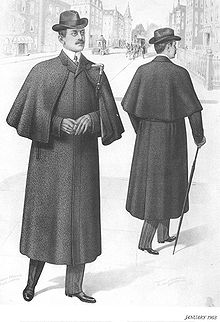
The name ulster was given to a form of overcoat designed by John Getty McGee (1816-1883) who had a shop in High Street in Belfast and owned the Ulster Overcoat Company.

At that time male travellers used to wear greatcoats, fitted with capes and other accessories, which covered them from head to toe. These kept them warm but were awkward to wear. McGee decided to make a coat that would give more freedom of movement. Several designs were tried before the Ulster was evolved and it was so successful that a woman’s model was made also. Orders poured in from all over the world and the design was extremely popular and profitable. 

The great fictional detective Sherlock Holmes had a liking for the ulster overcoat. He first appeared in A Study in Scarlet in 1887 and at one point in the story he was described as ‘enveloped in an ulster’. An ulster overcoat was also worn by Billy Connolly when he was playing Queen Victoria’s ghillie, John Brown, in the 1997 film Mrs Brown

The success of the ulster led on to the design of an ulsterette, which was defined as ‘a light ulster’ and the creation of the word ulstered, which meant ‘wearing an ulster’.

The word Ulster is used as an adjective as well as a noun but there are also the words Ulsterite and Ulsterian.  Ulsterite can be used as a noun, meaning an Ulsterman or Ulster person, and occasionally it has been used as an adjective meaning ‘of or associated with Ulster’.

In November 1912 the Ulster Unionist MP Ronald McNeill achieved notoriety when he hurled a book at Winston Churchill in the House of Commons and one newspaper headline read ‘Wild Ulsterite Attacks Winston Churchill’.

The following year the New York Times (28 September 1913) reported a speech in Chicago by Lord Northcliffe with the headline ‘Cannot Coerce Ulsterites: So Says Lord Northcliffe, Who Doesn’t Expect Home Rule.’ Again in 1916 the New York Times referred to the ‘prospects of an Ulsterite-Nationalist Agreement’.

The word was used on both sides of the Atlantic and in reviewing a publication by James Connolly, the Socialist Standard (June 1914), which was published by the Socialist Party of Great Britain, referred to the ‘struggle between Home Ruler and Ulsterite’.

An Irish-born American named William Bourke Cockran addressed the Committee on Foreign Relations of the United States Senate in Washington on 30 August 1919. He spoke at some length on the subject of Ireland and in doing so he repeatedly referred to Ulstermen as ‘Ulsterites’.  Later that year, in December 1919, the Chicago Tribune also described Sir Edward Carson as an Ulsterite. 

With the appointment of the Boundary Commission to review the border between the Free State and Northern Ireland, the New York Times (29 October 1924) carried a report with the headline ‘Ulsterite on Boundary Board’. 
The word also appeared in settings that were not related to Ulster politics and it was used by a number of American historians. In 1921 James T Adams used the word in his book The Founding of New England, where he said that ‘the Puritanism of any individual today may derive from an ancestral Pennsylvanian Ulsterite’.  Another historian, Professor Thomas J Wertenbaker, wrote The Planters of Colonial Virginia, which was published in 1922 by Princeton University Press and Oxford University Press. In it he referred to ‘the poor Ulsterite' who arrived in America in the 18th century. 

Dr H M Klein wrote A History of Lancaster County in Pennsylvania in 1926 and said, 'It is generally recognized that the first dominant Scotch-Irish settlements in Lancaster county were in its 'Upper End' or northern part, not in the 'Lower End', as the five Scotch-Irish townships of southern Lancaster are sometimes called.  The settlement of the aggressive Ulsterites in Lancaster county seated a power which soon became evident in the local government.'  Again in The Annals of Southwestern Pennsylvania, written around 1939 by Lewis Clark Walkinshaw, an Ulster-Scots emigrant named John Laird is described as ‘an Ulsterite from County Donegal’.

Some years later, on 14 July 1947, away from politics and history, Time magazine described the famous Northern Ireland golfer Fred Daly as a ‘jaunty little Ulsterite’.

Rev Dr Robert F MacNamara, a Roman Catholic historian, used the word Ulsterite in the April 1963 edition of Rochester History to describe a young Roman Catholic woman who had emigrated from County Cavan to America.

The word is still used occasionally in America and appeared for example in a chapter in a book entitled Peace, Conflict and Violence: Peace Psychology for the 21st Century, which was published in 2001. There the authors spoke of ‘a possible Ulsterite identity … built on the richness of both cultures’.  It also appeared in an article by James A Haught, the news editor of The Charleston Gazette, in 2002 and again in the same year in a book by Professor Kimberly Cowell-Meyers of American University in Washington, who has written extensively on Northern Ireland politics. In her book Religion and Politics in the Nineteenth Century, she described the unionist reaction to the possibility of home rule and said, ‘Faced with the threat of home rule, the Irish Protestant minority … defined itself as separate again, as Scotch-Irish, as Ulsterite, and as unionist’.

The word Ulsterite was used in 2005 in an article published by a California division of the Ancient Order of Hibernians in America and as recently as 2007 Eric P Kaufman used the word Ulsterite in The Orange Order: A Contemporary Northern Irish History, when he said that Brian Faulkner ‘displayed his national identity as British rather than Ulsterite’.

Today the word is comparatively rare but it is an alternative word for an Ulsterman and it is also used in relation to a resident of Ulster County in New York.
The word Ulsterian is an adjective referring to the province of Ulster or to a geological division. The latter meaning is derived from Ulster County in the state of New York and is a subdivision of the American Devonian period.  The use of the word Ulsterian in relation to the province of Ulster has been less common than the use of the word Ulsterite, but it does appear in dictionaries and can be found in some other publications. 

On 27 June 1918 the New York Times considered the possibility of a federal United Kingdom ‘including Wales, Scotland, England, the two Irelands, North and South – if non-Ulsterian Ireland can be brought to consent to that division’.

The word was also used by the famous writer J R Tolkien, author of Lord of the Rings, who said of his friend, the author C S Lewis, that he had an ‘Ulsterian motive’.

Queen's Speech

This year the Queen's speech on Christmas Day was broadcast from Hampton Court because it was there in 1604 that King James I convened the conference that was to lead to the translation of the Authorised or King James Version of the Bible.  The Authorised Version was published in 1611 and next year is the 400th anniversary of that important event.

In her speech the Queen spoke about the relevance of the Christian faith and the contribution of the King James Bible to the culture of our nation. 

She also referred to sport but that accounted for just one third of the speech, about 2 min 41 seconds out of 7 min 18 seconds.  Nevertheless most media reports, both before and after, preferred to ignore her comments on Christianity and the Bible and instead they focused on her comments about sport. 

Is this not a reflection of the way in which the media today marginalise the Christian faith? 

Monday, 27 December 2010

Thomas Buchanan Read

Recently the News Letter had an article about Thomas Buchanan Read, an American poet and portrait painter, who was born in Chester County, Pennsylvania on 12 March 1822.  It was an interesting article but omitted to mention that he was of Ulster-Scots ancestry.

His great-grandfather Rev Thomas Read DD was born in Chester County in March 1746 and was the son of Scotch-Irish immigrants from Ulster.  He was educated at the Philadelphia Academy under Dr Francis Alison, a Presbyterian minister from Ulster, and in 1768 he was licensed as a Presbyterian minister.

Thomas Read was pastor of of the Presbyterian congregation in Drawyer's Creek in Delaware from 1768 to 1798, when he moved to the Second Presbyterian Church in Wilmington, Delaware.  He remained there until 1817, when he resigned and thereafter he preached from time to time in the First Presbyterian Church in Wilmington, which was without a pastor.  In 1796 Princeton College awarded him the degree of Doctor of Divinity.

During the American Revolution he was an earnest patriot and in 1776 he and some fifty others, his neighbours and members of his congregation, shouldered their muskets and marched to Philadelphia.  However their assistance was unnecessary and they were able to return home.  The following year George Washington sent for Read to provide information on the geography of the surrounding country prior to the Battle of Brandywine.

Dr Thomas Read had four sons and one of them, James Read, who was a school-teacher, married Hannah Buchanan and they were the grandparents of Thomas Buchanan Read.

Thomas B Read started work as a painter in Cincinnati in 1839 but in 1841 he moved to Boston and there his poetical talents developed, first finding expression in the columns of the Boston Courier.  Read moved to Philadelphia in 1846 and his first volume of poetry was published in 1847.  Among the portraits he painted were Abraham Lincoln, Henry Wadsworth Longfellow, Alfred Tennyson, Elizabeth Barrett Browning, Robert Browning and William Henry Harrison.
 
Read made several visits with his family to Europe but returned to America in 1861, at the start of the Civil War.  He enrolled as a volunteer in the Union Army and served under General Lew Wallace, who was also of Scotch-Irish ancestry, but perhaps his most important support for the Union cause was through his patriotic poems and addresses.
 
After the war his health deteriorated and he spent the winter of 1871-72 in Rome but in the spring he set off for America, believing that he would die there.  On board the steamer he developed pneumonia but managed to reach New York, where he died on 11 May 1872.  He was buried in North Laurel Hill Cemetery in Philadelphia.  Shortly before he died he wrote a letter in which he said:
I can look back upon all the poetry I have ever written, and find it contains no line breathing a doubt upon the blessed Trinity and the great Redemption of man.  When I have written my verses I have been alone with my own soul and with God, and not only dared not lie, but the inspiration of the truth was to me so beautiful that no unworthy thought ever dared obtrude itself upon the page.  This was entirely owing to the goodness of God, who saw what it was to be, and saved me from subsequent mortification and regret.
Most of the above is taken from History of Chester County, Pennsylvania, with genealogical and biographical sketches, volume 2 (1881), by John Smith Futhey and Gilbert Cope.

Friday, 24 December 2010

Irish Labour Party

Recently on Facebook I seem to have acquired some 'friends' who belong to the Irish Labour Party.  I was therefore interested to read the following in an article by Kevin Myers in the Belfast Telegraph last night, 23 December.  The article had previously appeared in the Irish Independent on 21 December:
Most readers are now acquainted with the Rome Rule that emerged following independence.  By 1949 the Irish Labour Party boasted that its policies were based on papal encyclicals and that it acknowledged the authority of the Catholic Church in all policy matters.
It is easy for people in the Irish Republic to point the finger at Northern Ireland and brand us as a sectarian state but the fact is that for the first fifty years of the southern state Home Rule was indeed Rome Rule.  In spite of the efforts of some courageous politicans such as Noel Browne, Irish political parties, including the Irish Labour Party were largely subservient to Roman Catholic authority.

The situation in the Irish Republic has changed in recent years but what happened in the Republic helps us to understand what happened in Northern Ireland.

Shenandoah

I always enjoy watching a few western films over the Christas holidays and what better way to start than the old James Stewart classic Shenandoah.

Stewart plays the role of Charlie Anderson, a farmer in the Shenandoah Valley in Virginia.  He finds himself and his family caught up in the middle of the Civil War but decides not to get involved until his youngest son is taken prisoner by Union soldiers.

The story is set in Virginia, which had a large Scotch-Irish population, and the script was written by James Lee Barrett (1929-1989) from North Carolina, another state with a large Scotch-Irish population.  Indeed the Anderson family in the story were probably conceived by the script-writer as a Scotch-Irish family.


The star of the film, James Stewart (1908-1997), was certainly of Ulster-Scots descent and his family can be traced back through the generations to 1785 when William Stewart and his wife Margaret Gettys emigrated from county Antrim to America.

Patrick Wayne, son of John Wayne (1907-1979), played the role of James Anderson, one of the boys in the family, and he too was of Ulster-Scots descent.  John Wayne was born Marion Robert Morrison and in the 1950s he remarked to a reporter that he was 'just a Scotch-Irish little boy'.  His great-great-grandfather Robert Morrison enigrated from county Antrim to America in 1792.

The director was Andrew V McLaglen, who was born in London and was the son of the actor Victor McLaglen (1886-1959).  His grandfather was Rt Rev Andrew McLaglen, a bishop and primus of the Free Protestant Episcopal Church of England, an obscure denomination with just a few small congregations.

The inclusion of the old folk tune Shenandoah as a recurrent theme throughout the film adds to the enjoyment of a classic western.

Scotch Church, Armagh

Rev Pooley Shuldam Henry was minister of First Presbyterian Church in Armagh from 1826 to 1846, when he was appointed first president of the new Queen's College in Belfast.  During his rather stormy ministry sixty families memorialised Armagh Presbytery to form another congregation and Third Armagh was recognised by the presbytery on 7 November 1837.  The first minister Rev John Richard McAlister, originally from Garvagh, was installed on 13 June 1838 and services were held for a time in the old Methodist Church in Abbey Street. 

The meeting-house on The Mall was opened for worship on 11 February 1840 by Rev Dr Henry Cooke and above the door is the inscription SCOTCH CHURCH MDCCCXXXVII.  The year 1837 refers to the formation of the congregation rather than the opening of the building and the word Scotch reflects the Scottish roots of Presbyterianism in Ulster.

McAlister was very active and much used of God during the great Ulster revival in 1859.  There were many converts at that time and the congregation flourished. 

Tynan Abbey

The other day I was browsing through The Buildings of Co Armagh, a beautifully produced book which was written by the late Charles Brett and published by the UAHS in 1999. 

It includes Tynan abbey, which was the home of the Stronge family but on the night of 21 January 1981 the Provisional IRA murdered Sir Norman Stronge Bt and his son James, who were both former MPs, and then burned the 230-year old mansion.  The ruin stood for some years but was finally demolished in 1998.

The estate passed into the ownership of the Stronge family when Rev John Stronge, prebendary of Tynan, married Eleanor Manson.  According to Burke's Peerages, Rev John Stronge was a descendant of a certain Matthew Stronge of Strabane who was a scion of 'Strang of Balcaskie' in Fife, and who had been warden of Lifford in county Donegal.

The Stronges or Strangs were therefore of Scottish origin  and they were not the only Scottish family to become major landowners in the area.  Charles Brett noted that:
The Tynan Abbey demesne of the Stronge family in county Armagh; the Caledon demesne of the Alexander family in county Tyrone; and the Glaslough demesne of the Leslie family, just across the border in county Armagh; together comprise a very considerable area of parkland, woodland, farmland and lakes, through which twine the rivers Tynan, Cor and Blackwater.
The three families, Stronge, Alexander and Leslie, were all of Scottish origin and the three estates constitued a large area in south Ulster.