Sunday, 16 April 2017

A little language difficulty on Achill

I was amused by this short article by columnist Sandra Chapman in the New Letter on Saturday (15 April), not because of the decline in spoken Irish, which is part of the cultural wealth of the island, but because of Sandra's closing observation.

Deserted village on Achill Island
I have just spent the most glorious weekend in Co Mayo where the mountains on Achill Island really do sweep down to the sea.
Tourists flock here even in spring.  There's lots of accommodation, eating places and space to park a car.
A sunny, warm day had us visiting an abandoned village at the foothills of one of those mountains.  It had a history stretching back to the 1300s.
Life could not have been easy in such tiny stone built cottages, shared with their animals.
I asked a local man if he could tell me how to say goodbye in Irish.
He didn't know.  'We speak English here,' he said.
I doubt if Sinn Fein would want to know that.
No Sandra, they probably wouldn't!

According to the website www.mayo.ie - 'In Mayo, the Gaeltacht areas of Iorras (Erris), Acaill (Achill), Inis Bigil (Inishbiggle) and Tuar Mhic Eadaigh (Tourmakeady) are rich in folklore, sanctuaries for writing, music, historical and archaeological sites.'

Achill lies within the Mayo Gaeltacht, which has a population of just 11,000 people, but even there most people do not speak Irish every day and some don't speak it at all.  This was confirmed in the recent census and even an Official Languages Act, with Irish Gaelic as the first official language of the state hasn't helped.


Saturday, 15 April 2017

Easter weekend in the Gaeltacht Quarter

West Belfast has its own 'tourist agency', Failte Feirste Thiar, with its own website and information for tourists and visitors to the city.  You can view it at www.visitwestbelfast.com  

The current page offers a wide variety of cultural activities over the Easter period and here are just a few examples of what is on offer in the west of the city.


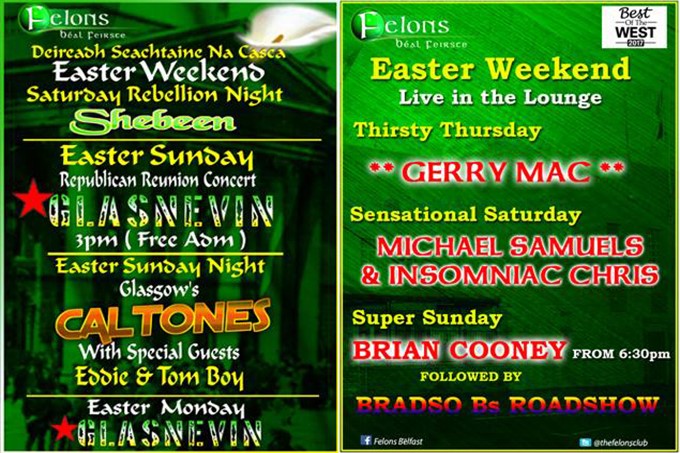
The Felons Club is advertised as 'the best in the west'  with Saturday Rebellion Night, starring Shebeen, and a Republican Reunion Concert on Easter Sunday.

Shebeen specialise in Irish rebel music with a wide repertoire of songs praising the Provisional IRA.  They also perform that classic Irish song 'Go on home British soldiers, go on home' with its call to 'F..k your Union Jack, we want our country back.'

Alternatively you might prefer the Ceili Mor in the Devenish Inn, for which the advertisement features three notable republican women, Mairead Farrell, Maire Drumm and Sheena Campbell.


On the other hand tourists might choose the Andersonstown Social Club and if this have missed Shebeen in the Felons Club they can catch up with them in the Andersonstown Social Club on Monday night.

And anyone seeking a little exercise is invited to join the members and patrons of the Andersonstown Social Club walking in the Easter Republican Parade.

Is there no end to what the Gaeltacht Quarter has to offer?  Yes that's the new name for the Falls.

Now of course Sinn Fein want to develop Gaeltachts, or Irish language areas, as part of their Irish Language Act, and you may have been wondering what a 'Sinn Fein Gaeltacht is like.  Well wonder no more! 

Friday, 7 April 2017

'Irish language in danger of becoming extinct'

Yesterday the summary results of the 2016 census for the Irish Republic were published by the Central Statistics Office in Dublin.  

The total population, as of April 2016, was 4,761,865 people and the summary provided information about a wide range of issues.  One of these was the use of the Irish language, or Gaelic language, which is an official language of the state, along with English and there is an Official Languages Act (2003).

However the census revealed that usage of the Irish language is declining, even in the Gaeltacht areas, which are the language heartlands.

Altogether, our of the total population of 4,761,865, only 1,761,420 said that they spoke Irish.  This represents 39.8% of the population, a drop from 41.4% in 2011.  On the other hand 60.2% of the population cannot speak Irish.

The census also asked how often people speak Irish and there are some people who speak Irish every day, but they are very few in number.  In the whole of the Irish Republic, with a population of 1,761,420, only 73,803 said they speak it daily outside the education system, a fall of 3,382 on the 2011 figure.  That represents just 1.5% of the population.

The situation in the Gaeltacht areas, the traditional Irish language heartlands, was particularly alarming for language enthusiasts.  You might imagine that everyone there spoke Irish on a daily basis but in fact only 21.4% of a total population of 96,090 in the native speaking population said they spoke Irish on  daily basis.  This represents a decrease of 11.2% since 2011.

Henry McGee, writing in the Irish Times actually said that 'Irish is in danger of becoming extinct as a native language.'

Meanwhile Dr John Walsh of the Department of Irish in the National University of Ireland, Galway, described the census figures as 'worrying'.

Now the census summary was being reported by RTE on its website last night. but that report made no mention of the Irish language figures.

So was it on the BBC Northern Ireland news website?  The census related to the Irish Republic but BBC Northern Ireland news often strays across the border.  No I couldn't find any report  there.

Then perhaps Stephen Nolan or William Crawley covered it on Radio Ulster.  Between them the two programmes have three hours of broadcasting but today neither touched on the Irish language figures in the census.

Eventually I found it on the BBC News website on the Europe page!  Now if that means all news about the Irish Republic will in future be on the Europe news page rather than the Northern Ireland news page so be it.  It's where it should be but generally isn't.  Moreover I doubt if many people in Northern Ireland check out the Europe page.  Nevertheless I will do in future.

Then I also discovered that there is a Republic of Ireland section below the Northern Ireland news  on the website and it was there as well.  However because language was mentioned in the headline I doubt if many people would have read down to the relevant section.

As regards live news reports on radio and television, I didn't manage to hear any Radio Ulster news on Friday or see the BBC Northern Ireland news on television., but I will certainly ask.

In any case, the BBC is clearly aware of the information, so will it be covered by either Nolan or Talkaback on Monday?

Will Pobal, Sinn Fein, the SDLP and the other advocates of an Irish Language Act in Northern Ireland be asked to comment on it?

If the BBC can send Stephen Walker to Wales to report on the Welsh Language Act will they now send him over the border to report on what has happened in the Republic?

Turning then to newspapers there were census reports in a number of daily newspapers and it was interesting to compare and contrast the reports.  The three Northern Ireland daily newspapers all carried reports on the census figures as did the Irish Times, the Irish Examiner and the Irish Independent.

All of them reported the census but only five of the six newspapers reported the decline in the use of the Irish language, while one newspaper omitted it completely and that was the Irish News.

Interestingly both the News Letter and the Irish News had taken their reports from Ed Carty, a journalist with the Press Association.  Everything that was in the Irish News report was also in the News Letter report but the section covering the Irish language was missing entirely from the Irish News version.

We can only speculate as to why the Irish News, an avowedly nationalist newspaper, didn't want to report this news.

The BBC is our public service broadcaster and it has given extensive coverage to news stories about the Irish language, indeed I was on The View last night in discussion with an Irish speaker.  So why was the story of the Republic's census figures ignored ... or was it censored?  Admittedly it is a negative story about Irish but the BBC is always ready to carry negative stories about other cultural traditions and other expressions of cultural identity.  So what happened this time?

Surely in the context of the ongoing debate about an Irish Language Act in Northern Ireland, this story has a special relevance?

For those who want to see the official summary of the census this is the link:

https://static.rasset.ie/documents/news/census-2016-summary-results-part-1-full.pdf

Tuesday, 14 March 2017

Sinn Fein's call for a Border Poll

In the wake of Nicola Sturgeon's call for a constitutional referendum in Scotland, Sinn Fein have repeated their long-standing demand for a border poll here as well.

Michelle O'Neill and Sinn Fein MLAs but no Gerry Kelly

The call was made by their Stormont leader Michelle O'Neill, who was surrounded in the Great Hall by a number of Sinn Fein MLAs.  However noticeable by his absence from the photograph was veteran republican Gerry Kelly.

Of course there was a previous Border Poll and that was held on 8 March 1973.  It was boycotted by both Sinn Fein and the SDLP, as was their democratic right, and the result was that 98.9% of those who voted were in favour of Northern Ireland remaining within the United Kingdom.

Old Bailey car bomb which injured two hundred people
The republican movement boycotted the 1973 Border Poll but they did mark it in another way.  On the day of the poll in Northern Ireland, a team of IRA terrorists, including Gerry Kelly, placed a car bomb at the Old Bailey in London.

A victim of the Old Bailey bomb
Two hundred people were injured and one man died from a heart attack brought on by the bomb.  This was the start of the Provisional IRA bombing campaign in Great Britain.

I don't know why Sinn Fein omitted Gerry Kelly from their set-piece statement in the Great Hall but in view of his role on the day of that Border Poll they were certainly wise to do so.

A new Border Poll can only be called by the Northern Ireland Secretary of State if he believes that there is likely to be a majority for a United Ireland and there is no evidence for that.  Many nationalists who vote for the SDLP and even some of those who vote for Sinn Fein actually prefer the benefits of the United Kingdom to the prospect of a United Ireland.

Even the Republic's Minister for Foreign Affairs, Charlie Flanagan TD, has said it would be 'premature' and 'for another day'.  Not much enthusiasm there!

The Sinn Fein demand is simply a repetition of a long-standing demand and one that is designed to be divisive and destabilising.  Remember what the independence referendum campaign did to Scotland.


Saturday, 11 March 2017

An Irish language strategy, an anither yin forbye

High Court in Belfast
Recently the High Court in Belfast ruled that the Northern Ireland Executive had breached its statutory duties by failing to implement an Irish language strategy.  

Judge Paul Maguire ruled in favour of a judicial review brought by the Irish language group Conradh na Gaeilge (Gaelic League), who said the Executive had not made good on a commitment to adopt an Irish language strategy as set out in the St Andrews Agreement Act and the Programme for Government 2011-2015.

This was an important decision and not just for the Irish language community because the ruling also meant that the Northern Ireland Executive had failed in its duty to implement an Ulster-Scots strategy.

The St Andrews Agreement Act included two commitments, one for Irish and one for Ulster-Scots.
The Executive Committee shall adopt a strategy setting out how it proposed to enhance and protect the development of the Irish language.
The Executive Committee shall adopt a strategy setting out it proposed to enhance and develop the Ulster-Scots language, heritage and culture.
There was also a requirement on the Executive Committee to 'keep under review each of the strategies'.

The St Andrews Agreement Act required the development of an Irish language strategy, not an Irish Language Act, and it also required the development of an Ulster-Scots strategy.  Moreover since the principle of 'equality' is so central to the governance of Northern Ireland we would expect these two strategies to be similar in their ambitions, aspirations and impact.

Caral Ni Chuilin (Sinn Fein)
Caral Ni Chuilin, the Sinn Fein Minister for Culture, Arts and Leisure, did bring forward strategies for Irish and Ulster-Scots but since these were cross-cutting and contentious they required Executive approval and they did not receive that approval.

There were two reasons why they did not receive DUP approval.  The first was that the Irish strategy included a specific commitment to an Irish Language Act and the second was that, in spite of Sinn Fein's  rhetoric about 'equality' there was no equity between the two strategies.  The Irish strategy was a gold-plated strategy whereas the Ulster-Scots strategy was lacking in scope, substance and vision.

As a result there was no endorsement from the DUP ministers and the two strategies which had been drawn up under the Sinn Fein minister were left languishing.

Therefore the legal case taken against the Executive by Conradh na Gaeilge and the ruling by Judge Maguire has implications for Ulster-Scots language, culture and heritage, as well as the Irish language.  


Friday, 10 March 2017

Balance in the BBC

This week has passed very quickly.  I have started to clear up constituency cases as the first step in closing down my constituency office.  However that will take some time.

Alongside that I have spent two days in Armagh at a workshop for the Commission on Flags, Identity Culture and Tradition.  Over the past few months the Commission has held public meetings and sectoral meetings across Northern Ireland to hear as many views as possible.  Because of other commitments I was only able to attend the consultation event in the Spectrum Centre but if the other events were as frank and forthright as that one it was a very useful process.  The next stage for the Commission is to collate and consider the issues that have been raised but there will be another nine months of work before a final report is produced.

As well as interviews for both BBC and UTV on language issues, I have taken part in several radio programmes including Nolan, Talkback and the other Nolan radio programme on Five Live.  I also have a television programme lined up for Monday night and continue to write a weekly column in the Belfast Telegraph.

The BBC is a 'public service broadcaster', paid for by the public, and has particular responsibilities as regards fairness and balance.  I took the opportunity to highlight that issue of balance, especially in regard to commentators and contributors.  It seems to be that too often it is the same people on the same programmes, time after time after time.  Simply relying on a handful of journalists and academics, who comprise the current 'commentariat', does not provide the necessary balance.  Even this morning a journalist from a unionist background highlighted to me some more examples of the imbalance and others have done the same.

For that reason I welcomed the opportunities of the past week and next week.  However there is need for a comprehensive review by the BBC and others of how they select their contributors and commentators, not just as regards political balance but other balances as well.

If we are to build a shared and better future in Northern Ireland, then the broadcast media have a role to play and this is an issue they need to address.

It is something I plan to return to in the Belfast Telegraph next week.


Sunday, 5 March 2017

Confidence and contentment

I would like to thank all those who helped in my election campaign in North Belfast and the 4,056 people who gave me their first preference votes.

I was first elected to Belfast City Council in 1989 and then to the Northern Ireland Assembly in 2003, so that is almost 28 years of service as a councillor and then MLA.

Even before I was elected in 1989 I had been involved as an activist for many years, so political, community and cultural activism have been a significant part of my life, alongside home and Christian faith.

So as well as thanking election workers and voters I want to thank my wife Mary who has been so tolerant of the many demands on my time and energies.  We were married in 1974 and she has a wonderful wife for the past forty-three years.

Quite a number of people of people have asked me how I feel about the election results and I have to say that I am disappointed at the overall result.  It was a very black day for Ulster and for many things that I hold dear.  However today is not the day for political analysis.  Instead I want to make this a very personal post.

Ever since Thursday two Bible verses has been very much in my mind and reflect how I view it at a personal level.

The first verse is Romans 8:28 - all things work together for good to them that love God.  That is a wonderful promise from a Sovereign God.  We may not understand the how or the why of things at the time but we can rest on that promise.

The second verse is Philippians 4:11 - I have learned, in whatsoever state I am, therewith to be content.

I am therefore reflecting on what doors of opportunity there are ahead and I believe there are ways in which I can advance the causes that remain near and dear to my heart.